Harper Brooks · 26 September 2026
Examining How Engineered Internal Cavities Reshape Acoustic Wave Behavior in Advanced Composite Materials
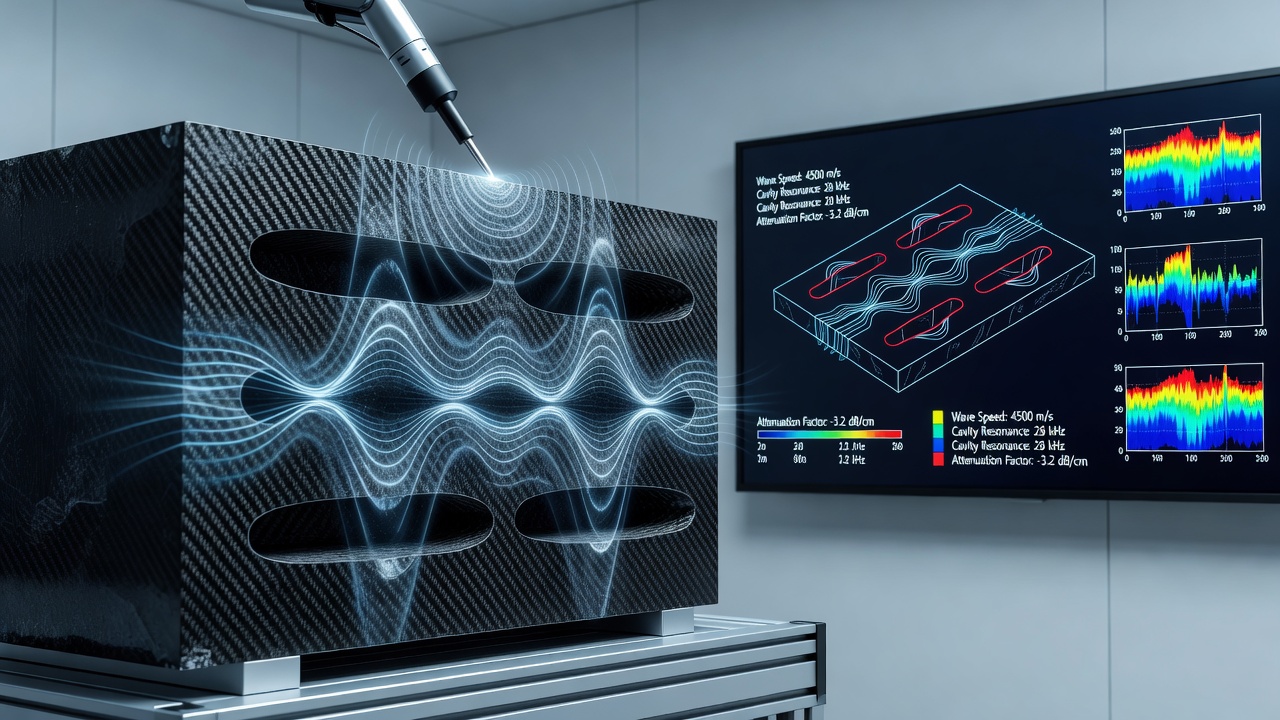
Researchers design internal cavities within advanced composite materials to control how acoustic waves propagate, scatter, and dissipate energy. These cavities, created through precise manufacturing techniques such as additive layering or sacrificial templating, introduce interfaces that alter wave paths inside materials like carbon-fiber-reinforced polymers and ceramic matrix composites. Data from laboratory tests show that cavity geometry, size distribution, and spacing directly influence reflection, refraction, and absorption coefficients across frequency ranges from audible sound to ultrasonic regimes. Engineered cavities function as scatterers that disrupt coherent wave fronts, and studies indicate this disruption creates frequency-dependent band gaps where propagation stops entirely. In phononic crystal arrangements, periodic cavity placement produces stop bands that block specific wavelengths, while aperiodic distributions yield broader absorption through multiple scattering events. Measurements collected at facilities such as those operated by the National Institute of Standards and Technology reveal attenuation increases of up to 40 decibels in targeted bands when cavity volume fractions reach 15 to 25 percent.Design Principles and Fabrication Methods
Engineers tailor cavity shapes ranging from spherical voids to elongated channels or lattice-based pores to match desired acoustic outcomes. Finite element modeling predicts that aspect ratio and orientation relative to wave incidence angles determine whether cavities primarily reflect or trap energy. Fabrication processes now incorporate laser drilling, micro-molding, and 3D printing of sacrificial cores that burn out or dissolve after matrix consolidation, leaving controlled void networks without compromising structural integrity.
Composite layups often embed these cavities between fiber plies or within resin-rich regions, and post-cure inspection via X-ray tomography confirms dimensional accuracy within micrometer tolerances. Research conducted at European institutions including the Fraunhofer Institute for Mechanics of Materials demonstrates that graded cavity distributions, with density varying through thickness, produce impedance matching layers that reduce surface reflections and enhance transmission loss over wider bandwidths.
Acoustic Performance Metrics and Measurement Approaches
Transmission loss, absorption coefficients, and dispersion relations serve as primary metrics when characterizing cavity-modified composites. Impedance tube experiments measure normal incidence absorption, while reverberation chamber tests capture diffuse field behavior in full-scale panels. Researchers at Australian universities have documented that cavity resonance frequencies align with incident wave spectra to maximize viscous and thermal losses inside narrow channels connecting voids.

September 2026 brings new datasets from ongoing international collaborations that track long-term stability of cavity structures under cyclic loading and environmental exposure. These updates show minimal degradation in acoustic performance after 10,000 fatigue cycles when cavity surfaces receive protective coatings. Active voice measurements using laser Doppler vibrometry further confirm that local cavity resonances couple with global plate modes, shifting natural frequencies and damping ratios in predictable ways.
Applications in Aerospace, Automotive, and Infrastructure
Aircraft fuselage panels incorporating cavity arrays achieve weight savings while meeting stringent cabin noise targets, and wind tunnel data indicate reductions in turbulent boundary layer noise. Automotive body components use similar designs to attenuate engine and road noise without added mass, and fleet trials report measurable drops in interior sound pressure levels. Bridge decks and rail vehicles employ cavity-tuned composites for vibration control, extending service life by limiting fatigue from resonant excitation.
One documented case involved a prototype helicopter rotor blade where internal cavities tuned to blade passing frequencies lowered radiated noise by 6 decibels, according to test reports from Canadian aerospace research centers. Such outcomes arise because cavities convert acoustic energy into localized heat through boundary layer friction and resonance damping, rather than allowing waves to radiate outward.
Modeling Advances and Future Characterization Needs
Multiscale simulation frameworks now couple continuum mechanics with discrete element methods to predict cavity-induced scattering across length scales from nanometers to centimeters. Validation against experimental dispersion curves improves model fidelity, and machine learning surrogates accelerate optimization of cavity layouts for broadband performance. Observers note that standardization of test protocols remains essential as cavity complexity increases, particularly for non-periodic arrangements that defy simple analytical solutions.
Conclusion
Engineered internal cavities provide a versatile route to reshape acoustic wave behavior in advanced composites by introducing controlled scattering, resonance, and absorption mechanisms. Fabrication precision and modeling accuracy continue to advance, supported by measurement campaigns that quantify performance under realistic conditions. Integration into structural components across transportation sectors demonstrates practical utility, while ongoing data collection through 2026 refines understanding of durability and optimization strategies.